
HIFU in Istanbul
HIFU is a non-surgical treatment that uses focused ultrasound energy to support tissue tightening and gradual collagen remodelling. It may be considered for people with mild to moderate skin laxity around the lower face, jawline or neck who are looking for a treatment without incisions.
HIFU is not a replacement for surgical lifting, and it cannot create the same degree of change in every patient. At our clinic in Üsküdar, Istanbul, treatment suitability is assessed according to facial structure, skin quality, tissue thickness, degree of laxity and the patient’s expectations.
What Is HIFU?
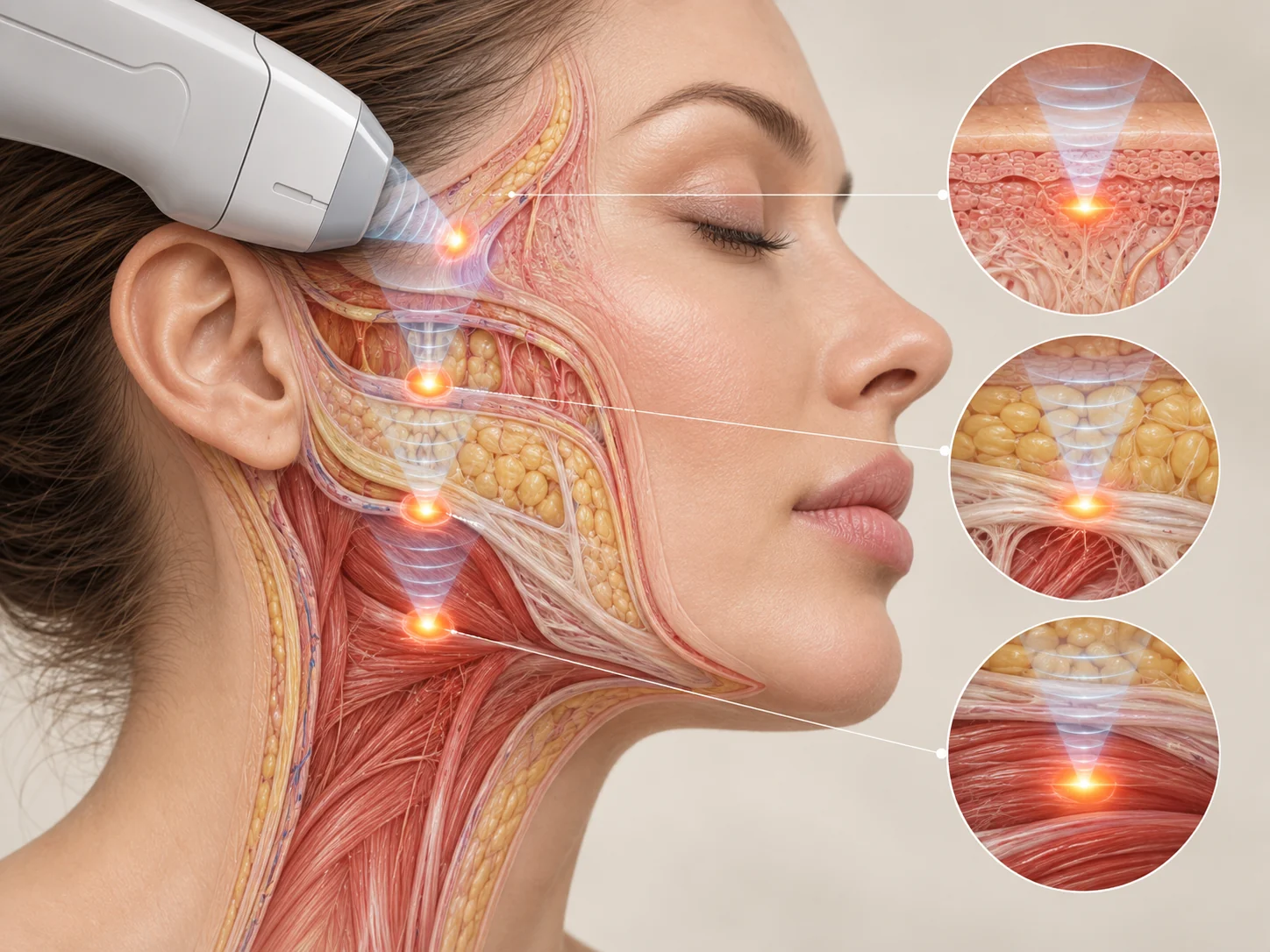
HIFU stands for high-intensity focused ultrasound. The technology delivers ultrasound energy to selected tissue depths without creating an incision in the skin.
The controlled thermal effect created within the targeted tissue may initiate a gradual repair and collagen-remodelling response. Focused-ultrasound systems used for aesthetic purposes are intended to produce temporary changes in physical appearance; the precise indication and treatment depth depend on the system being used.
Clinical studies suggest that focused ultrasound may improve selected cases of facial laxity, particularly around the cheeks, jawline and lower face. The degree of improvement, however, varies between individuals and is generally more subtle than a surgical result.
What Can HIFU Target?
Depending on the individual assessment, HIFU may be planned for:
- Mild loss of jawline definition
- Early lower-face laxity
- Mild skin looseness beneath the chin
- Selected areas of the neck
- Reduced firmness in the cheek or lower-face area
- Patients seeking gradual rather than dramatic change
HIFU does not add volume like a dermal filler and does not relax expression muscles like botulinum toxin. It is therefore important to determine whether the main concern is skin laxity, volume loss, muscle activity, fat distribution or a combination of these factors.
Who May Be Suitable for HIFU?
HIFU may be considered when:
- Skin laxity is mild or moderate
- The patient prefers a treatment without surgery or injections
- The facial tissues still have reasonable elasticity
- The goal is gradual refinement rather than an immediate transformation
- The patient understands that results vary
- A clinical examination confirms that focused ultrasound is appropriate for the treatment area
The best candidate is not determined by age alone. Two people of the same age can have very different skin thickness, facial volume, bone structure and ageing patterns.
Who May Not Be an Ideal Candidate?
HIFU may not be the most appropriate option when:
- Skin laxity is advanced
- Significant surgical lifting would be required to meet the expectation
- The main concern is facial volume loss rather than tissue laxity
- The treatment area has an active infection, open wound or significant irritation
- There is a medical or anatomical reason to avoid focused ultrasound
- The patient expects an immediate or surgical-level result
In some faces, excessive treatment or unsuitable patient selection may produce an undesired reduction in facial fullness. Treatment depth, energy and anatomical planning should therefore be individualised rather than applied as a standard protocol.
How Is HIFU Treatment Planned?
The consultation begins with an assessment of the face from the front, profile and oblique angles.
The physician evaluates:
- Jawline definition
- Lower-face and neck laxity
- Skin and subcutaneous tissue thickness
- Existing volume loss
- Facial asymmetry
- Areas that should not be treated
- Whether another treatment would better address the concern
The treatment plan may differ between the right and left sides of the face. The number of treatment lines, selected depths and energy approach should be adapted to the anatomy rather than determined by a single fixed package.
What Happens During Treatment?
The skin is cleaned and ultrasound gel is applied. The treatment handpiece is then positioned over the selected areas.
Patients may experience brief sensations of heat, tingling or tenderness as energy is delivered. Comfort varies depending on the treatment area, tissue thickness, energy settings and individual sensitivity.
The duration depends on the size and number of areas being treated.
When Can Results Be Seen?
Some patients notice an early feeling of firmness, but HIFU should primarily be viewed as a gradual treatment.
Collagen remodelling develops over time, so the appearance may continue to evolve over the following weeks and months. The degree and duration of change depend on:
- Baseline laxity
- Ageing pattern
- Skin quality
- Treatment area
- Selected treatment parameters
- Lifestyle and weight changes
- Individual biological response
A single universal timeline should not be promised. Follow-up photography under consistent lighting and positioning provides a more reliable assessment than day-to-day mirror observation.
Is There Downtime After HIFU?
Many patients return to their routine shortly after treatment. Temporary effects may include:
- Redness
- Local tenderness
- Mild swelling
- Tingling
- Sensitivity when touching the area
- Temporary altered sensation
- Occasional bruising
These effects are usually limited, but the intensity and duration vary. Persistent pain, increasing swelling, skin changes, weakness or an unexpected neurological symptom should be reported to the treating physician.
Is HIFU Safe?
Focused ultrasound is non-surgical, but non-surgical does not mean risk-free.
Safe planning requires knowledge of facial anatomy, appropriate treatment depth and careful energy selection. Potential adverse effects may include prolonged tenderness, bruising, temporary numbness, burns, contour changes or nerve-related symptoms. Complications are uncommon in appropriately selected and treated patients, but they should not be described as impossible.
Broad claims that every HIFU device has the same regulatory status or indications should be avoided. Device-specific clearances and intended uses differ. The treatment plan should be based on the actual system, treatment area and clinical assessment.
HIFU or Dermal Filler?
HIFU and dermal fillers address different concerns.
HIFU is primarily considered for selected forms of tissue laxity. Dermal fillers are used when structural support or volume replacement is required.
Adding filler to a face whose main concern is laxity may not solve the problem. Similarly, treating a face with substantial volume loss using HIFU alone may not create the desired balance.
A combined plan may be considered, but treatments should not be combined automatically. Sequence and timing depend on the anatomy and treatment goal.
HIFU or Botulinum Toxin?
Botulinum toxin reduces selected muscle activity. HIFU targets tissue at planned depths through focused ultrasound.
Expression lines caused by muscle movement are not treated in the same way as lower-face laxity. During consultation, the physician determines whether the concern is primarily related to muscle activity, tissue laxity, volume loss or skin quality.
HIFU for International Patients in Istanbul
Patients visiting Istanbul should allow enough time for an in-person examination before treatment.
Before travelling, it is helpful to provide:
- Clear photographs from the front and both profiles
- Previous aesthetic treatment history
- Relevant medical information
- Dates of arrival and departure
- Whether any other facial procedures are planned
A preliminary remote discussion may help organise the visit, but final suitability and treatment parameters are determined after physical examination.
For travel planning, the International Patients page can help organise practical details.
Frequently Asked Questions
Is HIFU the same as a facelift?
No. HIFU is a non-surgical treatment and cannot reproduce the tissue repositioning achieved by surgery.
How many HIFU sessions are needed?
The number of sessions depends on the treatment area, baseline laxity, device parameters and response. A fixed session count is not appropriate for every patient.
Can HIFU reduce facial fat?
Energy delivered at unsuitable depths may affect subcutaneous tissue. In a face with limited volume, this may be undesirable. Facial thickness and treatment depth must therefore be assessed carefully.
Can I combine HIFU with other treatments?
It may be combined with other procedures when clinically appropriate, but the order and interval should be planned by the physician.
HIFU Consultation in Üsküdar, Istanbul
HIFU planning should begin with identifying the actual cause of the concern. Skin laxity, facial volume, muscle activity and fat distribution are evaluated separately before treatment is recommended.
The aim is not to apply the maximum possible energy. It is to use an anatomically appropriate plan for the right patient and treatment area.
HIFU, fat distribution and patient selection
Focused ultrasound is intended to deliver energy at selected tissue depths, but more energy is not necessarily better. Excessive or poorly targeted treatment may cause pain, burns, altered sensation or unintended fat changes. A lean face, significant volume loss and severe skin laxity may require a different strategy. HIFU is not a universal substitute for surgery, and devices marketed under similar descriptions may differ in evidence and treatment characteristics.
HIFU appointments in Istanbul: realistic timelines
Dr. Fuat Yurtseven’s clinic is located at Akasya Acıbadem, Acıbadem Mahallesi, Çeçen Sokak, Akasya AVM Kent Etabı B1 Blok D:21, Üsküdar, Istanbul. An assessment should review facial volume, skin laxity, previous energy-based treatment and desired timing. Results, if achieved, can evolve over weeks to months rather than being guaranteed on the day of treatment. If you are travelling from abroad, discuss follow-up options and your travel window in advance; see International Patients.

You can request a personal assessment about this topic.
You can contact our clinic on WhatsApp about this treatment.